


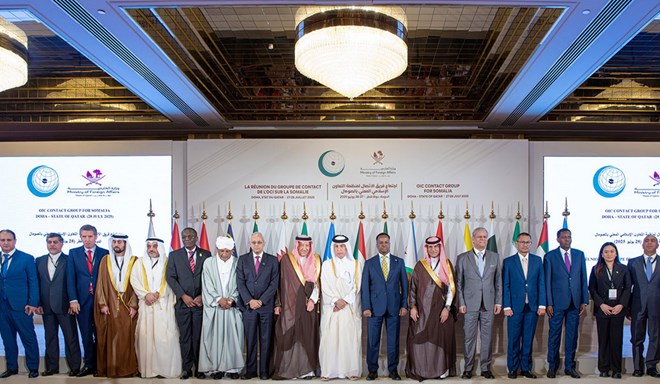
The city of Doha hosted a pivotal ministerial-level meeting of the Organisation of Islamic Cooperation (OIC) Contact Group on Somalia, focusing on ramping up international support to strengthen Somalia’s security infrastructure, foster development, and enhance long-term stability for the Somali people.
Qatar’s Minister of State for Foreign Affairs, Sultan Bin Saad Al-Muraikhi, addressing the gathering, emphasized that holding the conference in Doha reflects the collective commitment of OIC member states to stand with Somalia and its people as they navigate the path towards peace and sustainable development.
Al-Muraikhi highlighted that this meeting comes at a critical juncture when Somalia faces overlapping challenges threatening its security, sovereignty, political stability, and economic growth. He underscored that the global community bears an increased responsibility to unify efforts in support of Somalia’s national rebuilding journey.
The Minister stressed that respecting Somalia’s sovereignty and territorial integrity remains a non-negotiable principle and must serve as the foundation for all international engagement with the country.
He called for accelerating a comprehensive national reconciliation process built on inclusive dialogue that involves all internal stakeholders. This, he noted, is essential to healing divisions and establishing strong, trusted state institutions based on collaboration and mutual respect.
Al-Muraikhi further stated that political reforms are the backbone of Somalia’s state-building and stabilization efforts, including preparations for credible national elections, completing the constitutional framework, and establishing transparent, democratic institutions.
He insisted that this process must be inclusive, involving the Federal Government, Federal Member States, civil society, women, youth, and grassroots organizations to ensure broad-based representation and a sustainable, Somali-led consensus.
The Qatari Minister also emphasized that while international support is vital, it should reinforce—rather than overshadow—the leadership of Somalia’s Federal Government, respecting its autonomy and independent decision-making.
He affirmed that Qatar will continue providing humanitarian, development, and relief assistance, directly or through partnerships with UN agencies and international organizations, to help alleviate the hardships facing the Somali people.
In conclusion, Al-Muraikhi called for harmonized and impactful international efforts, stressing that all external support must align with Somalia’s own national priorities to ensure lasting impact and ownership by the Somali government and people.

