


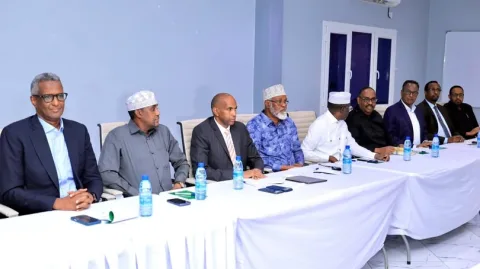
MOGADISHU, February 23, 2026 — High-level negotiations between Somalia’s Federal Government and the opposition-aligned Somali Future Council have ended without agreement, intensifying political uncertainty as the mandates of federal institutions are set to expire in three months.
The talks, held over several days at the Presidential Palace in Mogadishu, focused on electoral arrangements and constitutional reform. Both sides had sought to reach a settlement before the current term concludes, but discussions concluded in what participants described as a critical impasse.
In a press statement issued Monday, the Somali Future Council said it entered the negotiations to prevent political instability and secure a timely, negotiated electoral process. However, the council accused the federal government of pursuing unilateral constitutional amendments without broad national consensus or sufficient public consultation.
The opposition alliance reaffirmed that the 2012 Provisional Constitution remains Somalia’s legal foundation and argued that any amendments must preserve the federal balance of power and be grounded in inclusive political agreement. The federal government has maintained that the constitutional review process will proceed.
A central point of disagreement was the electoral model. President Hassan Sheikh Mohamud’s administration continues to advocate for a nationwide one-person, one-vote system as the long-term direction for Somalia’s political transition. The Somali Future Council rejected that approach at this stage, instead supporting indirect elections with broader representation, similar to recent processes in Puntland and Jubbaland.
The council also called for state-level elections in Galmudug, Hirshabelle and Southwest to be conducted in accordance with existing state constitutions and federal principles. It further demanded a political agreement before April 14 outlining the process, timetable and administration of Federal Parliament elections.
In its statement, the council said it would not accept “a constitutional amendment, a snap election, or an extension of the term,” framing its position as a defense of constitutional order and negotiated elections.
Despite the breakdown, the opposition alliance said it remains open to “genuine and fruitful dialogue” aimed at reaching an electoral agreement before constitutional mandates expire. The federal government has not issued detailed remarks on the outcome but indicated that further engagement remains possible.
The collapse of the talks underscores the depth of disagreement over Somalia’s electoral future at a pivotal moment in the country’s political transition.

