


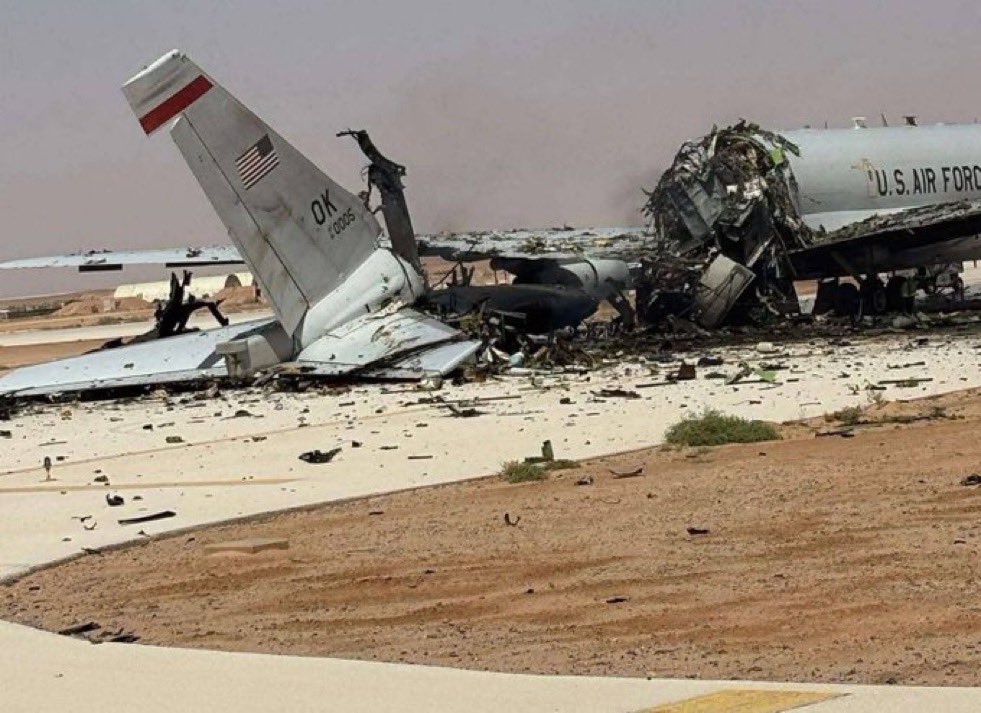
Images and reports show severe damage to a U.S. Air Force E-3G Sentry AWACS aircraft at Prince Sultan Air Base in Saudi Arabia following an Iranian missile and drone attack on March 27, 2026.
Open-source intelligence analysts (OSINT) confirmed the aircraft’s tail number as #81-0005, one of the E-3Gs recently deployed to the base for Operation Epic Fury, reducing the U.S. E-3 fleet from 16 to 15 aircraft.
The damage is concentrated at the aircraft’s radar dome and AN/APY-2 Surveillance Radar System, its most critical operational components. Defense analysts say the strike appears deliberately targeted at the sensitive systems rather than incidental.
Reports indicate the attack involved at least six ballistic missiles and 29 armed drones. At least 15 U.S. service members were wounded, five seriously. CENTCOM has not officially confirmed details, though the Wall Street Journal reported multiple aerial refueling aircraft and the AWACS were damaged.
The E-3 Sentry provides airborne command, control, surveillance, and early warning capabilities, linking fighters, bombers, and ground forces across the theater. Its loss significantly reduces U.S. ability to monitor threats, coordinate air operations, and respond to attacks.
Several KC-135 Stratotanker refueling aircraft were also heavily damaged, with one completely destroyed and three others out of service.
The IRGC confirmed targeting U.S. refueling and support aircraft, claiming several heavy aircraft were destroyed or seriously damaged. Analysts suggest Iran had access to advanced intelligence, possibly supported by allies like China and Russia, allowing precise strikes on critical U.S. platforms.
This strike highlights Iran’s capability to target high-value U.S. assets and demonstrates the vulnerability of coalition air operations in the region during ongoing military campaigns.

